Attraction of the Week: Pluto-Palooza at the Lowell Observatory
Disclaimer: We are not paid to promote any restaurant, hotel, activity, product, or attraction. All opinions are subjective and based on our personal experience. Your experience may be different.

The Lowell Observatory, located just 1 mile from downtown Flagstaff, Arizona atop a mesa known as Mars Hill, is most famous for being the site of the discovery of Pluto. This spac was founded in 1894 by Boston mathematician/astronomer Percival Lowell, and today is one of the oldest in the country.
In 2011, the observatory was recognized as “One of the world’s 100 most important places,” by TIME. Flagstaff was awarded the title of World’s 1st International Dark Sky City on October 24, 2001. This means it is the perfect place for stargazing due to minimal light pollution. Since moving to the area, Mike and I have been enjoying stargazing at various locales throughout the city like Buffalo Park.
Amazing views!
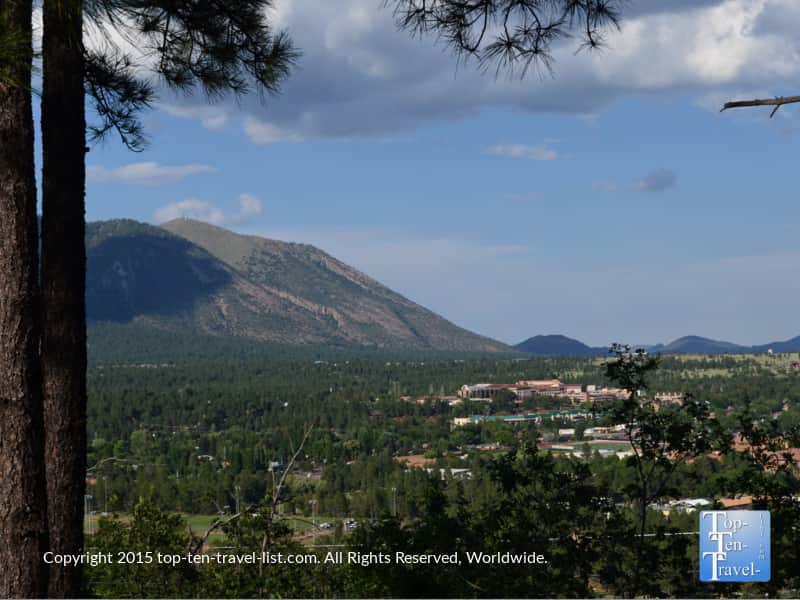
First off, the observatory is a great place to simply enjoy the mesmerizing mountain scenery – although really I could say the same thing about many places in this city. The tree-lined grounds are beautiful. The views of the city and mountains are gorgeous. If anything, I recommend a drive up here to take in the vista.
There are places to sit and relax while enjoying the views, along with a short educational path where you can learn some new facts about each planet. At night, it’s a great place to take in the starry skies & city lights.
The telescope used to discover Pluto
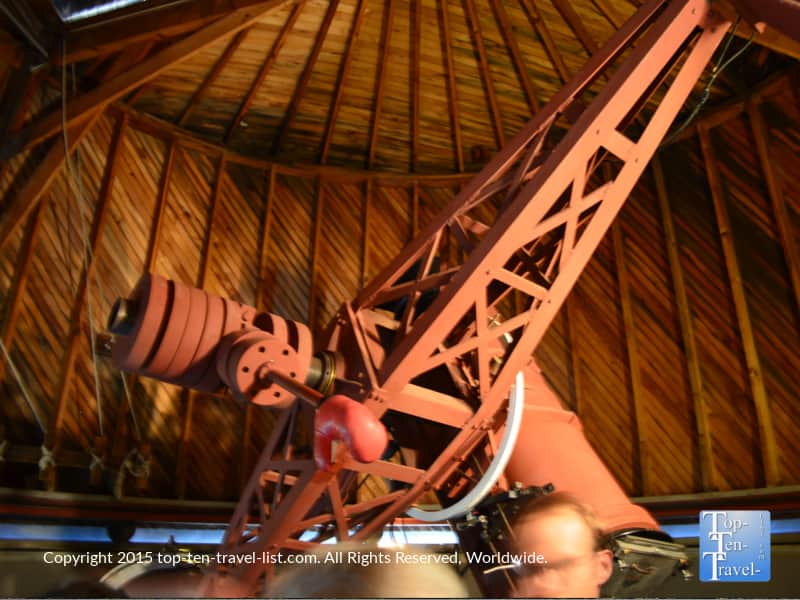
During your visit, you will have the opportunity to take a look at the telescope which was used back in 1930 by Clyde Tombaugh to discover Pluto. This is part of which makes this observatory so famous! It was pretty cool to see the instrument used in such a historic event. I am glad that I had this unique opportunity while living in this great city.
While it was considered the 9th planet to be discovered back in the day, the International Astronomical Union reclassified it as a dwarf planet in 2006. You can read more in this Library of Congress article.
Pluto-Palooza
We have been so busy hiking the beautiful trails since moving here that we didn’t think twice about visiting this observatory until we heard about a special event taking place called Pluto-Palooza. During a special event dedicated to commemorating the first photos of the planet, we had the opportunity to take part in a special celebration which included speeches, an interesting liquid nitrogen presentation, telescope viewing, and a viewing of the planet on a large screen.
The celebration was over NASA’s New Horizon probe obtaining images of the planet after being launched 9 years prior. These images were taken over 3 billion miles away. The high resolution photos (which we got to view during our visit), have enabled scientists to see what Pluto actually looks like, as opposed to just guessing in the past. These photos, which were taken 7750 miles above the surface of the planet were captured on July 13th, and are considered an amazing milestone in the astronomy field.
It was an interesting event to attend and we walked out with a lot more knowledge of astronomy. The staff seemed to be very excited and provided very enthusiastic & detailed presentations. They definitely kept us more than interested despite it feeling almost like a school lesson. I found The Pluto & NASA’s New Horizons presentation as well as the Cosmic Zoom to be the most interesting.
Other notable discoveries at Lowell
During our visit, we learned that Pluto was not the only discovery made here.
- Co-discovery of the rings of Uranus in 1977
- Discovery of the 3 largest stars
- Gyrochronology – determining the age of a star
- Accurate orbits of Pluto’s 2 new moons
- Pluto’s atmosphere
- …and many more
The Telescopes
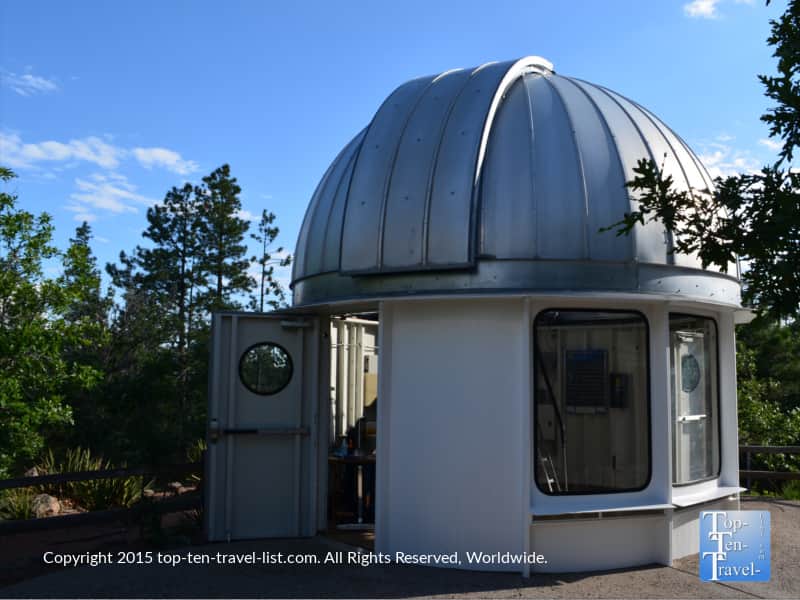
The McAllister telescope is used exclusively for public viewing.
The Discovery Channel Telescope, a 4.3 meter, $53 million dollar telescope, is the 5th largest in the world. It is located 40 miles Southwest of Flagstaff in Happy Jack.
The Clark Refractor, which recently underwent renovations, is a 24 inch refracting telescope built in 1895, originally used by Lowell to research intelligent life on Mars. Today it is used mainly for educational purposes.
There are 4 telescopes at the Anderson Mesa research location, just 10 miles Southeast of Flagstaff. The 72 inch Perkins telescope, the 110 inch John S. Hall telescope, the 31 inch NURO telescope, and the Navy Precision Optical Interferometer are amongst those found here.
Rotunda Museum
The Rotunda Museum houses several displays including one detailing the discovery of Pluto, Lowell’s importance in mapping the moon for the Apollo program, Percival Lowell’s extensive research on Mars, V.M. Slipher’s discovery that our universe is expanding, and a history of the Lowell family. This also where the Comsic Zoom presentation takes place here. The museum is open for nightly shows and daytime tours.
Things to do during your visit
Solar Viewing – From 12:30pm-dusk, you will be able to view the sun through a special solar telescope.
Public telescope viewing – On clear evenings, you will get to observe the night skies using the 16 inch McAllister telescope, the Clark Telescope, and/or by way of portable telescope set up in front of the Rotunda Museum. You can also view objects during the day at the McAllister Dome from 10am-5pm.
Story of Pluto tours – At 2:30, 3:30, & 4:30, a historical tour is offered. You will learn more about Clyde Tombaugh and the iconic telescope used in his discovery.
Lowell tours – See the telescope used to discover Pluto. Tours offered at 1:15, 2:15 & 3:15.
Colors of the Cosmos – Family friendly experiments using light and fire in the Giclas Lecture Hall in the Steele Visitor Center (6pm daily).
Constellation Tours – Tips and tricks for spotting constellations. 9pm (also 9:30 on weekends).
The Pluto Walk – A 350 foot outdoor walk where you will learn more about our solar system and enjoy the peaceful, beautiful grounds.
Times are subject to change. Please check the website for updates.
Overall, I believe a visit to this observatory is a worthwhile option for those interested in space/astronomy who are visiting or passing through the Flagstaff area. The presentations are interesting & educational, the grounds are beautiful, and having the opportunity to look through a telescope is always an interesting experience. We enjoyed our experience at this special event and will come back in the future for more stargazing.
Directions & Admission
The Observatory is located at: 1400 West Mars Hill Road.
Hours are 10am-10pm (Sunday until 5) year round.
Prices are $35 per adult, $30 for seniors, $20 for ages 5-17. Pricing updated as of 2026. Check the website for updated info and special events.
UPDATE: We have explored so much in our years living in this beautiful region. I wrote a comprehensive guide to the best-of-the-best in Northern Arizona. You will find great hikes in the ponderosa forest, jaw dropping red rock hikes in Sedona, amazing local restaurants, historical sites, and much more.